STEM education and critical consciousness
Faculty insights and reflections
DOI:
https://doi.org/10.32674/rh1an525Keywords:
culturally responsive pedagogy, critical consciousness, STEM Teacher educatorsAbstract
Culturally responsive pedagogy (CRP) offers a framework for equity-driven teaching, yet its third tenet—critical consciousness—is often neglected in both research and practice. This study explored how STEM teacher educators (STEs) intentionally deepened their critical consciousness as part of their teaching and scholarship. Drawing on interviews with 10 STEs across STEM education disciplines, we used cross-case analysis to identify three key themes that highlight how STEs think about and work to deepen their critical consciousness: personal motivations rooted in lived experience, an awareness of power dynamics in education, and ongoing self-reflection. The findings provide strategies for teacher educators seeking to foster critical consciousness in both their practice and in the preparation of preservice teachers. This study contributes to the growing call for equity-centered faculty learning and offers practical implications for embedding CRP more fully into STEM teacher education.
References
Berger, R. (2015). Now I see it, now I don’t: Researcher’s position and reflexivity in qualitative research. Qualitative Research, 15(2), 219–234. doi:10.1177/1468794112468475
Bjorklund Jr, P., Warstadt, M. F., & Daly, A. J. (2021). Finding satisfaction in belonging: Preservice teacher subjective well-being and its relationship to belonging, trust, and self-efficacy. Frontiers in Education, 6, 639435. doi:10.3389/feduc.2021.639435
Bowen, G. A. (2008). Naturalistic inquiry and the saturation concept: A research note. Qualitative Research, 8(1), 137-152. doi:10.1177/1468794107085301
Calabrese Barton, A., & Tan, E. (2020). Beyond equity as inclusion: A framework of “Rightful Presence” for guiding justice-oriented studies in teaching and learning. Educational Researcher, 49(6), 433-440. doi:10.3102/0013189X20927363
Ciampa, K., Reisboard, D. M., & McHenry, N. C. (2022). What analysis reveals about teacher educators’ understanding of culturally responsive instruction and translation into practice. The Teacher Educator, 57(4), 365–385. doi:10.1080/08878730.2022.2066742
Crenshaw, K. (1989). Demarginalizing the intersection of race and sex: A Black feminist critique of antidiscrimination doctrine, feminist theory and antiracist politics. University of Chicago Legal Forum, 1, 139–167.
Fasavalu, T. I., & Reynolds, M. (2019). Relational positionality and a learning disposition: Shifting the conversation. The International Education Journal: Comparative Perspectives, 18(2), 11–25.
Freire, P. (2000). Pedagogy of the oppressed. New York, NY. Continuum.
Gay, G. (2002). Preparing for Culturally Responsive Teaching. Journal of Teacher Education, 53(2), 106–116. doi:10.1177/0022487102053002003
Gist, C., Jackson, I., Nightengale-Lee, B., & Allen, K. (2019). Culturally responsive pedagogy in teacher education. Oxford research encyclopedia of education.
Harding, S. G. (1994). Is science multicultural? Challenges, resources, opportunities, uncertainties. Configurations, 2(2), 301–330. doi:10.1353/con.1994.0019
Han, H. S., Vomvoridi-Ivanović, E., Jacobs, J., Karanxha, Z., Lypka, A., Topdemir, C., & Feldman, A. (2014). Culturally responsive pedagogy in higher education: A collaborative self-study. Studying Teacher Education, 10(3), 290-312. doi:10.1080/17425964.2014.958072
Hutchison, L., & McAlister-Shields, L. (2020). Culturally responsive teaching: Its application in higher education environments. Education Sciences, 10(5), 1-12. doi:10.3390/educsci10050124
Jacobson, D., & Mustafa, N. (2019). Social identity map: A reflexivity tool for practicing explicit positionality in critical qualitative research. International Journal of Qualitative Methods, 18, 1-12. doi:10.1177/1609406919870075
Jones, B. L., & Donaldson, M. L. (2021). Preservice science teachers’ sociopolitical consciousness: Analyzing descriptions of culturally relevant science teaching and students. Science Education, 106(1), 3-26. doi:10.1002/sce.21683
Jones, B. L., & Taylor, J. C. (2022). Within the walls of the classroom: How science teachers’ instruction can develop students’ sociopolitical consciousness. Science Education, 106(5), 1021–1031. doi:10.1002/sce.21727
Killpack, T. L., & Melón, L. C. (2016). Toward inclusive STEM classrooms: What personal role do faculty play? CBE - Life Sciences Education, 15(3), es3. doi:10.1187/cbe.16-01-0020
Kincheloe, J. L. (2008). Critical Pedagogy Primer (2nd ed.). Peter Lang.
Kolovou, M. (2023). Embracing culturally relevant education in mathematics and science: A literature review. Journal of Educational Research, 45(3), 123–145. doi:10.1007/s11256-022-00643-4
Landreman, L. M., Rasmussen, C. J., King, P. M., & Jiang, C. X. (2007). A phenomenological study of the development of university educators’ critical consciousness. Journal of College Student Development, 48(3), 275-296. doi:10.1353/csd.2007.0027
Ladson-Billings, G. (1995). Toward a theory of culturally relevant pedagogy. American Educational Research Journal, 32(3), 465–491. doi:10.3102/00028312032003465
Ladson-Billings, G. (2014). Race, research, and urban education. In H. R. Milner & K. Lomotey (Eds.) Handbook on Urban Education (pp. 433–450). New York, NY: Routledge.
Leal, P. (2021). The development of the teacher attitudes to discrimination in language education scale: A measurement tool of critical consciousness for language teachers. Education Sciences, 11(5), 200. doi:10.3390/educsci11050200
Madkins, T. C., & McKinney de Royston, M. (2019). Illuminating political clarity in culturally relevant science instruction. Science Education, 103(6), 1319–1346. doi:10.1002/sce.21542
Merriam, S. B., & Tisdell, E. J. (2016). Qualitative research: A guide to design and implementation. San Francisco, CA. Jossey-Bass.
Mensah, F. M. (2012). Positional identity as a lens for connecting elementary preservice teachers to teaching in urban classrooms. In M. Varelas (Ed.), Identity construction and science education research: Learning, teaching, and being in multiple contexts. Bold Visions in Educational Research (Vol 35, pp. 105–121). Sense Publishers.
Mensah, F. M., & Jackson, I. (2018). Whiteness as property in science teacher education. Teachers College Record, 120(1), 1–38. doi:10.1177/016146811812000108
National Center for Education Statistics. (2019). Status and trends in the education of racial and ethnic groups 2018. (NCES 2019-038) Retrieved from https://nces.ed.gov/pubs2019/2019038.pdf
Nolan, K., & Keazer, L. (2021). Developing as culturally responsive mathematics teacher educators: Reviewing and framing perspectives in the research. International Journal of Humanities Social Sciences and Education, 8(9), 151-163. doi:10.20431/2349-0381.080901
Parhar, N., & Sensoy, O. (2011). Culturally relevant pedagogy redux: Canadian teachers’ conceptions of their work and its challenges. Canadian Journal of Education, 34(2), 189-218.
Pérez, F. C. (2022). Exposure/formation: A process for developing transformative education frameworks and critical consciousness in higher education. Journal of Latinos and Education, 21(2), 115–127. doi:10.1080/15348431.2019.1620108
Prater, M. A., & Devereaux, T. H. (2009). Culturally responsive training of teacher educators. Action in Teacher Education, 31(3), 19–27. doi:10.1080/01626620.2009.10463525
Probst, B. (2015). The eye regards itself: Benefits and challenges of reflexivity in qualitative social work research. Social Work Research, 39(1), 37–48. doi:10.1093/swr/svu028
Ragoonaden, K. (2015). Self-study of teacher education practices and critical pedagogy: The fifth moment in a teacher educator’s journey. Studying Teacher Education, 11(1), 81–95. doi:10.1080/17425964.2015.1018886
Rivera Maulucci, M. S. (2013). Emotions and positional identity in becoming a social justice science teacher: Nicole’s story. Journal of Research in Science Teaching, 50(4), 453–478. doi:10.1002/tea.21081
Roberts, K., Dowell, A., & Nie, J.-B. (2019). Attempting rigour and replicability in thematic analysis of qualitative research data: A case study of codebook development. BMC Medical Research Methodology, 19(1), 1-8. doi:10.1186/s12874-019-0707-y
Russo‐Tait, T. (2022). Color‐blind or racially conscious? How college science faculty make sense of racial/ethnic underrepresentation in STEM. Journal of Research in Science Teaching, 59(10), 1822–1852. doi:10.1002/tea.21775
Shimek, C., Appleget, C., Myers, J., & Hogue, B. (2023). Wobbling our way to culturally proactive pedagogies: Achieving flow in US teacher education. Journal of Education for Teaching, 49(1), 53-68. doi:10.1080/02607476.2022.2038516
Shultz, M., Close, E., Nissen, J., & Van Dusen, B. (2023). Enacting culturally relevant pedagogy when “Mathematics has no color”: Epistemological contradictions. International Journal of Research in Undergraduate Mathematics Education, 1-30. doi:10.1186/s40594-022-00349-9
Teo, T. W. (2015). Inside versus outside the science classroom: Examining the positionality of two female science teachers at the boundaries of science education. Cultural Studies of Science Education, 10, 381–402. doi:10.1007/s11422-014-9581-4
Underwood, J. B., & Mensah, F. M. (2018). An investigation of science teacher educators’ perceptions of culturally relevant pedagogy. Journal of Science Teacher Education, 29(1), 46–64. doi:10.1080/1046560X.2017.1423457
Xie, J., & Ferguson, Y. (2022). STEM faculty’s perspectives on adopting culturally responsive pedagogy. Teaching in Higher Education, 1–19. doi:10.1080/13562517.2022.2129960
Downloads
Published
Issue
Section
License
Copyright (c) [year] [author]
This work is licensed under a Creative Commons Attribution 4.0 International License.
This license permits unrestricted use, distribution, and reproduction in any medium, provided the original author and source are credited. https://creativecommons.org/licenses/by/4.0
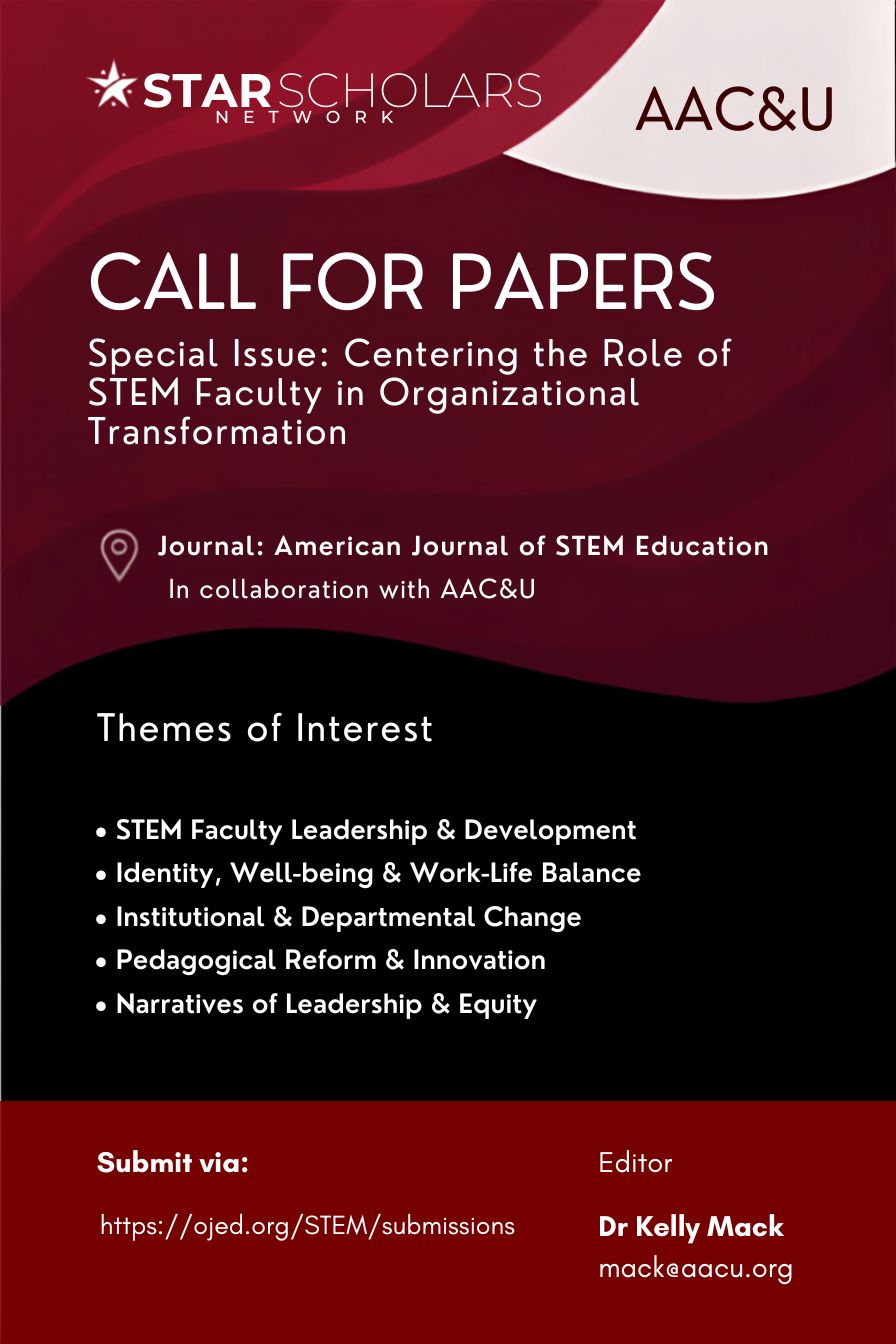
 Call for Special Issue Proposals