Centering the Role of STEM Faculty in Organizational Transformation
In collaboration with the American Association of Colleges and Universities (AAC&U)
Call for Papers
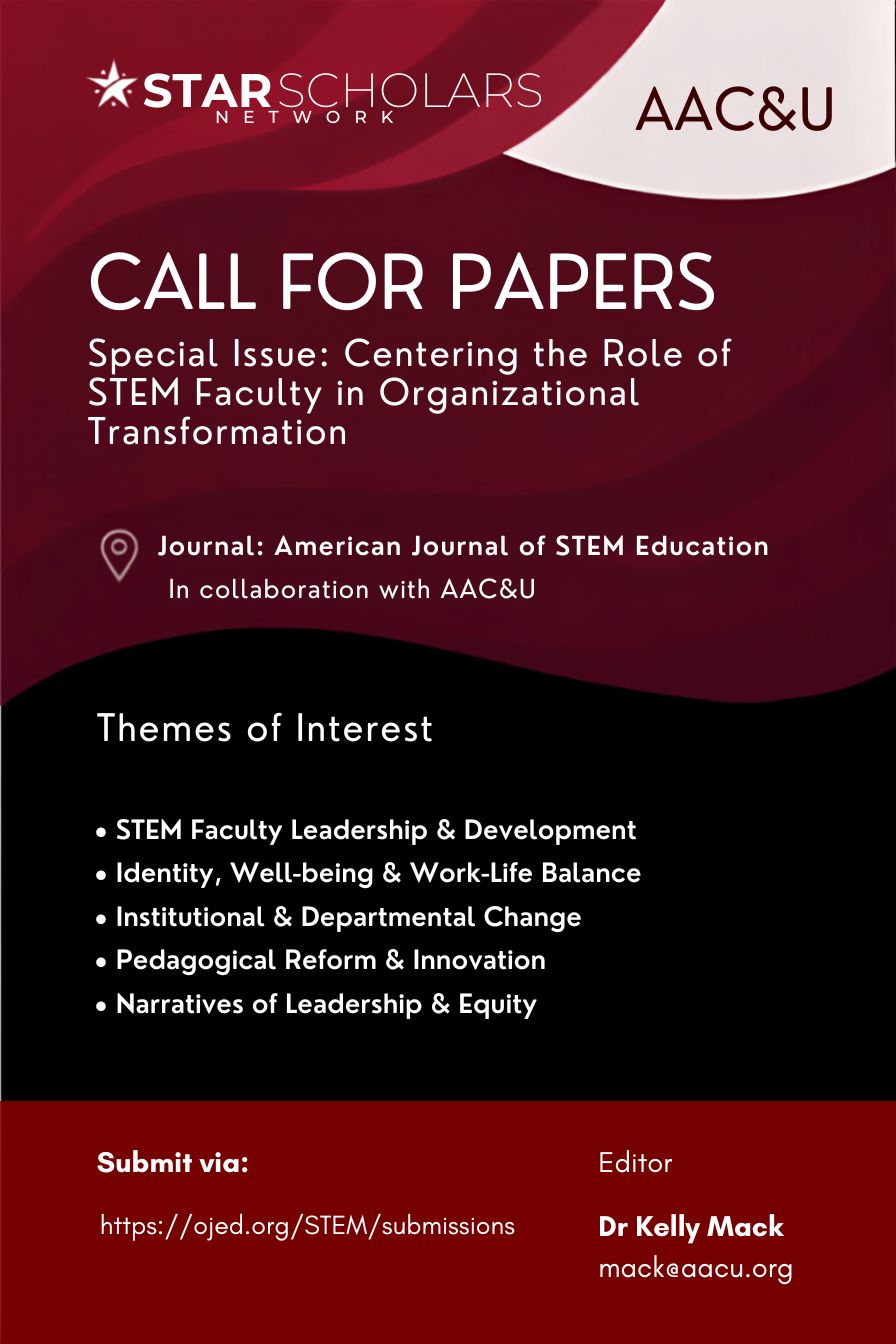
Centering the Role of STEM Faculty in Organizational Transformation
The American Journal of STEM Education invites scholarly submissions for a special issue focused on organizational issues in STEM education with particular emphasis on the faculty experience. This special issue, developed in collaboration with experts from the American Association of Colleges and Universities (AAC&U), will explore how STEM faculty – and the systems and structures designed to support them and advance their careers – serve as essential catalysts for institutional and departmental transformation, pedagogical innovation, and organizational change.
AAC&U has over a decade of experience in delivering professional development initiatives that position STEM faculty as central actors and change agents in undergraduate STEM reform. Like others, its evidence-based approaches to faculty development place faculty – their personal and professional well-being and leadership capacity – at the center of all transformation. This special issue will showcase a broad range of individual and institutional perspectives addressing organizational development challenges in STEM higher education and offer innovative and proven solutions rooted in faculty-centered frameworks that inform how STEM faculty are empowered to lead, champion inclusion, and navigate complex institutional structures.
Themes and Topics of Interest
We welcome empirical research, personal leadership narratives, reflective case studies, and conceptual papers that address, but are not limited to, the following:
- Novel Approaches to STEM Faculty Leadership and Professional Development
Theoretical frameworks, empirical methods, and evidence-based strategies for building, cultivating, and measuring STEM faculty capacity to design, lead, and implement reform in curriculum, policy, governance, and undergraduate STEM education ecosystems. - STEM Faculty Well-being
Exploration of psychological safety, emotional labor, radical rest, workload fatigue, resilience building, productivity trauma, energy and mental health management, leadership as lifestyle, and work-life integration and balance in organizational contexts. - Leadership Development for STEM Faculty
Strategies for cultivating lifestyle leadership, inclusive practices, and cross-campus influence. - Culturally Responsive Professional Development
Analyses of STEM faculty self-efficacy and transformation following interventions focused on equity and inclusion. - Institutional and Departmental Change
Understanding the role of STEM faculty as primary agents and/or situational leaders in guiding reform in curriculum, policy, governance, and STEM education ecosystems. - Pedagogical Reform and Innovation
Demystifying and amplifying evidence-based strategies for empowering STEM faculty to improve teaching, assessment, and student learning outcomes. - Narratives of Leadership
Effective use of specific leadership styles and strategies aimed at reforming undergraduate STEM education through first-person leadership accounts and case studies from STEM faculty and/or administrators.
Submission Guidelines:
- Submissions must follow APA 7th edition style
- Articles may be submitted in English or Spanish
- Word count must be between 2,000–7,000 words (including references)
- Include an abstract (150–200 words) in both English and Spanish (if possible)
- Publication Date: Fall 2026
Submission Link: https://ojed.org/STEM/submissions
How to Submit
- You will need to create an account if you are submitting for the first time. https://ojed.org/STEM/submissions
- Select the “Special Issue: Reimagining STEM Faculty Leadership” from the drop-down menu during submission.
- Ensure your submission adheres to APA 7th edition formatting and includes all required metadata.
Editor:
Kelly Mack, Ph.D.
Office of Undergraduate STEM Education
American Association of Colleges & Universities
Washington, DC 20009
mack@aacu.org
Author Guidelines for Journal Manuscripts
To support academic integrity and writing quality, authors are expected to follow the structure and standards outlined below, which align with best practices in scholarly publishing and ethical AI usage.
Title and Abstract
- Title: Concise (≤15 words), specific, and keyword-rich. Avoid jargon and abbreviations.
- Abstract: 150–250 words summarizing background, purpose, methodology, findings, and implications.
- Keywords: Choose 5–7 relevant terms for indexing and discoverability.
Introduction
- Provide context with recent literature (5–7 current citations).
- Present a clear problem statement and research gap.
- Define research questions/hypotheses and significance.
Literature Review (excluding leadership narratives)
- Synthesize 15–20 scholarly works under 2–3 themes.
- Include 3–5 studies from the current year.
- Highlight trends, gaps, and connections to your study.
Research Methodology
- Clearly state the research design (qualitative, quantitative, or mixed methods).
- Describe sampling, data collection tools, procedures, and data analysis techniques.
- Address ethical considerations (e.g., IRB approval).
Results
- Present findings objectively:
- Quantitative: Include descriptive/inferential stats.
- Qualitative: Thematic summaries with quotes.
- Mixed: Separate and integrated strands.
- Max 4 tables/figures in APA 7th format.
Discussion
- Interpret results in relation to past studies.
- Emphasize implications, limitations, and future research directions.
Conclusion
- Summarize the purpose, method, and findings.
- Emphasize the study’s contribution and future relevance.
References
- Use APA 7th style.
- Ensure all in-text citations match reference entries.
- Include recent, peer-reviewed literature.
- See: https://aut.ac.nz.libguides.com/APA7th/Articles
Formatting and Language
- Clear, precise academic writing.
- Use section headings and proofread carefully.
- Limit tables/figures to four.
AI Use Policy and Acknowledgment
Generative AI tools (e.g., ChatGPT, Grammarly, QuillBot) may support:
- Brainstorming research questions
- Organizing or paraphrasing content
- Language refinement
However:
- All academic interpretation and synthesis must be human-generated
- AI must not fabricate data or citations
- Articles must include the following statement if AI tools were used:
AI Acknowledgment:
The author used generative AI tools (e.g., ChatGPT) to support the brainstorming, drafting, and language refinement stages. All academic content, citations, and interpretations were created and verified by the author.
In collaboration with the American Association of Colleges and Universities (AAC&U). For questions, contact: Dr. Kelly Mack at mack@aacu.org.

 Call for Special Issue Proposals