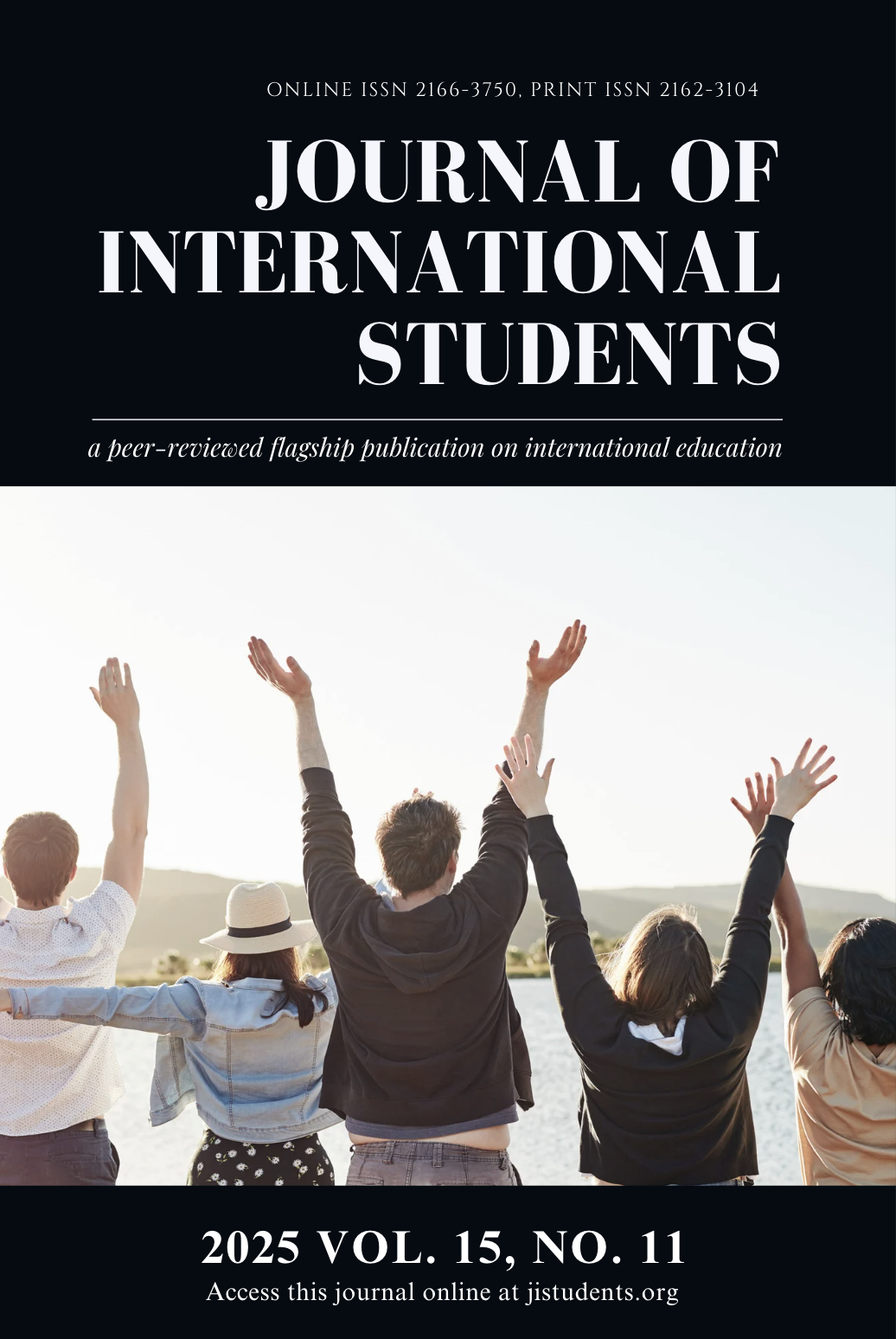
Migratory stress of Bangladeshi international students in Canadian postsecondary institutions
DOI:
https://doi.org/10.32674/zx4w0389Keywords:
international students, Bangladesh, migratory stress, acculturation, Ontario postsecondary institutionsAbstract
Bangladeshi international students in Canada have strong academic and economic potential but lack proper social integration, which exacerbates their psychosocial challenges. This study aimed to explore their psychosocial challenges to unearth those issues. A qualitative study was conducted with 10 female and male students to examine their social, economic, and personal challenges and identify their coping strategies. This study found that international students go through migratory stress, which comprises various internal and external stressors such as second language anxiety, self-imposed isolation, homesickness, insufficient financial preparation, discrimination, safety concerns, lack of employment opportunities, and weather unsuitability. This study’s findings highlight the need for better social integration, employment opportunities, and mental health support for the students so they can better assimilate into Canadian society.
References
Agrawal, S. K. (2013). Economic disparities among South Asian immigrants in Canada. South Asian Diaspora, 5(1), 7–34. https://doi.org/10.1080/19438192.2013.720514 DOI: https://doi.org/10.1080/19438192.2013.720514
Alqudayri, B., & Gounko, T. (2018). Studying in Canada: Experiences of female graduate students from Saudi Arabia. Journal of International Students, 8(4), 1736-1747. https://doi.org/10.5281/zenodo.1468078 DOI: https://doi.org/10.32674/jis.v8i4.228
Anderson, S. (2024). Indians Immigrate to Canada in Record Numbers. Forbes. https://www.forbes.com/sites/stuartanderson/2024/04/25/indians-immigrate-to-canada-in-record-numbers/
Anderson, T. (2020). International and refugee university students in Canada: Trends, barriers, and the future. Comparative and International Education, 48(2), 1-16. https://doi.org/10.5206/cie-eci.v48i2.10787 DOI: https://doi.org/10.5206/cie-eci.v48i2.10787
Arthur, N., & Flynn, S. (2013). International students’ views of transition to employment and immigration. Canadian Journal of Career Development, 12(1), 28-37. https://cjcd-rcdc.ceric.ca/index.php/cjcd/article/view/206
Atri, A., & Sharma, M. (2006). Designing a mental health education program for South Asian international students in United States. Californian Journal of Health Promotion, 4(2), 144–154. https://doi.org/10.32398/cjhp.v4i2.1940 DOI: https://doi.org/10.32398/cjhp.v4i2.1940
Austin, Z. (2007). Geographical migration, psychological adjustment, and re‐formation of professional identity: The double‐culture shock experience of international pharmacy graduates in Ontario (Canada). Globalisation, Societies and Education, 5(2), 239-255. https://doi.org/10.1080/14767720701427145 DOI: https://doi.org/10.1080/14767720701427145
Berg, B. L. (2001). Qualitative research methods for the social sciences (4th ed.). Allyn & Bacon.
Berry, J. W. (1997). Immigration, acculturation, and adaptation. Applied Psychology: An International Review, 46(1), 5-33. https://doi.org/10.1111/j.1464-0597.1997.tb01087.x DOI: https://doi.org/10.1111/j.1464-0597.1997.tb01087.x
Berry, J. W. (2006). Stress perspectives on acculturation. In D. L. Sam, & J. W. Berry (Eds.), The Cambridge handbook of acculturation psychology (pp.43–57). Cambridge: Cambridge University Press. DOI: https://doi.org/10.1017/CBO9780511489891.007
Bolger, K. (2023, September 19, 2023). Cost-of-living crisis hits foreign students in Canada. Asia Pacific Post. https://asianpacificpost.com/article/9803-cost-living-crisis-hits-foreign-students-canada.html
Braun, V., & Clarke, V. (2006). Using thematic analysis in psychology. Qualitative Research in Psychology, 3(2), 77-101. https://doi.org/10.1191/1478088706qp063oa DOI: https://doi.org/10.1191/1478088706qp063oa
Buckner, E., Knight-Grofe, J., & Eden, C. (2023). For students, look east; for partners, look west: How Canadian internationalization strategies portray Asia and Europe. In Ann H. K., E. Buckner, & J. M. Montsion (Eds.), International Students from Asia in Canadian Universities: Institutional Challenges at the Intersection of Internationalization, Inclusion, and Racialization (pp. 30-43). Routledge. https://doi.org/10.4324/b23160 DOI: https://doi.org/10.4324/b23160-4
Calder, M.J., Richter, S., Mao, Y., Burns, K.K., Mogale, R.S. & Danko, M. (2016). International students attending Canadian universities: Their experiences with housing, finances, and other issues. Canadian Journal of Higher Education, 46(2), 92-110. https://eric.ed.gov/?id=EJ1113439 DOI: https://doi.org/10.47678/cjhe.v46i2.184585
Castleberry, A., & Nolen, A. (2018). Thematic analysis of qualitative research data: Is it as easy as it sounds?. Currents in Pharmacy Teaching and Learning, 10(6), 807-815. https://doi.org/10.1016/j.cptl.2018.03.019 DOI: https://doi.org/10.1016/j.cptl.2018.03.019
CBC News. (2024). What’s behind the problems with Canada’s international student program?. https://www.cbc.ca/news/canada/intl-student-program-1.7095990
Chandra, Y., Shang, L. (2019). Inductive coding. In: Qualitative Research Using R: A Systematic Approach. Springer, Singapore. https://doi.org/10.1007/978-981-13-3170-1_8 DOI: https://doi.org/10.1007/978-981-13-3170-1_8
Chen, C. P. (1999). Professional issues: Common stressors among international college students: Research and counseling implications. Journal of College Counseling, 2(1), 49-65. https://doi.org/10.1002/j.2161-1882.1999.tb00142.x DOI: https://doi.org/10.1002/j.2161-1882.1999.tb00142.x
Chen, L. H. (2008). Internationalization or international marketing? Two frameworks for understanding international students’ choice of Canadian universities. Journal of Marketing for Higher Education, 18(1), 1-33. https://doi.org/10.1080/08841240802100113 DOI: https://doi.org/10.1080/08841240802100113
Costello, C. (2016). Safe country? says who?. International Journal of Refugee Law, 28(4), 601-622. https://doi.org/10.1093/ijrl/eew042 DOI: https://doi.org/10.1093/ijrl/eew042
Dayal, P. (2025, January). These international students are trying to find jobs. But a tight job market leaves them with few options. CBC News. https://www.cbc.ca/news/canada/windsor/international-students-worry-about-windsor-essex-s-highest-jobless-rate-1.7423499
Denzin, N. K., & Lincoln, Y. S. (Eds.). (2011). The SAGE handbook of qualitative research (4th ed.). CA: Sage.
Desai-Trilokekar, R., Thomson, K., & El Masri, A. (2016). International students as “ideal” immigrants: Ontario employers’ perspective. Ontario Ministry of Training, Colleges, and Universities, 1-78. file:///B:/%231%20Storage/InternationalstudentsasidealimmigrantsOntarioemployersperspective.pdf
Ferdaush, J., & Rahman, K. M. (2011). Gender inequality in Bangladesh. http://hdl.handle.net/2451/33900
Firang, D. (2020). The impact of the COVID-19 pandemic on international students in Canada. International Social Work, 63(6), 820-824. https://doi.org/10.1177/0020872820940030 DOI: https://doi.org/10.1177/0020872820940030
Ge, L., Brown, D., & Durst, D. (2019). Chinese international students’ experiences in a Canadian university: Ethnographic inquiry with gender comparison. Journal of International Students, 9(2), 582-612. https://doi.org/10.32674/jis.v0i0.272 DOI: https://doi.org/10.32674/jis.v0i0.272
Giamos, D., Lee, A. Y. S., Suleiman, A., Stuart, H., & Chen, S. P. (2017). Understanding campus culture and student coping strategies for mental health issues in five Canadian colleges and universities. Canadian Journal of Higher Education, 47(3), 136-151. https://doi.org/10.7202/1043242ar DOI: https://doi.org/10.47678/cjhe.v47i3.187957
Gill, P., Stewart, K., Treasure, E., & Chadwick, B. (2008). Methods of data collection in qualitative research: Interviews and focus groups. British Dental Journal, 204(6), 291-295. https://doi.org/10.1038/bdj.2008.192 DOI: https://doi.org/10.1038/bdj.2008.192
Government of Canada. (2010). Economic impact of international education in Canada - An update. Government of Canada. https://www.international.gc.ca/education/report-rapport/economic-impact-economique/sec_4.aspx?lang=en
Government of Canada. (2022). Economic impact of international education in Canada - 2022 update. Government of Canada. https://www.international.gc.ca/education/report-rapport/impact-2022/index.aspx?lang=eng
Govi, V., Liu, R., & Tian, I. L. (2023). Being too Asian: Migrant student time and resistance within the Canadian university. Canadian Journal of Cultural Studies, e20230019. https://doi.org/10.3138/topia-2023-0019 DOI: https://doi.org/10.3138/topia-2023-0019
Guion, L. A., Diehl, D.C., & McDonald, D. (2011). Conducting an in-depth interview: FCS6012/FY393, rev. 8/2011. EDIS, 2011(8). https://doi.org/10.32473/edis-fy393-2011 DOI: https://doi.org/10.32473/edis-fy393-2011
Gupta, T. D., & Gomez, B. (2023). International students and equity, diversity, and inclusivity (EDI) in Canadian universities: A critical look. In Ann H. K., E. Buckner, & J. M. Montsion (Eds.), International students from Asia in Canadian universities: Institutional challenges at the intersection of internationalization, inclusion, and racialization (pp. 72-85). Routledge. https://doi.org/10.4324/b23160 DOI: https://doi.org/10.4324/b23160-7
Houshmand, S., Spanierman, L. B., & Tafarodi, R. W. (2014). Excluded and avoided: Racial microaggressions targeting Asian international students in Canada. Cultural Diversity & Ethnic Minority Psychology, 20(3), 377–388. https://doi.org/10.1037/a0035404 DOI: https://doi.org/10.1037/a0035404
ICEF Monitor. (2024). Canada hosted more than 1 million international students in 2023. https://monitor.icef.com/2024/01/canada-hosted-more-than-1-million-international-students-in-2023/
Institute of International Education. (2023). A quick look at: Global mobility trends. Project Atlas. https://www.iie.org/wp-content/uploads/2024/01/Project-Atlas_Infographic_2023_2.pdf
IRCC. (2023). Temporary residents: Study permit holders – monthly IRCC updates. https://open.canada.ca/data/en/dataset/90115b00-f9b8-49e8-afa3-b4cff8facaee
IRCC. (2024). Canada to stabilize growth and decrease number of new international student permits issued to approximately 360,000 for 2024. https://www.canada.ca/en/immigration-refugees-citizenship/news/2024/01/canada-to-stabilize-growth-and-decrease-number-of-new-international-student-permits-issued-to-approximately-360000-for-2024.html
Kenyon, K., Frohard-Dourlent, H., & Roth, W. D. (2012). Falling between the cracks: Ambiguities of international student status in Canada. Canadian Journal of Higher Education, 42(1), 1-24. ISSN-0316-1218 DOI: https://doi.org/10.47678/cjhe.v42i1.1991
Khawaja, N. G., & Dempsey, J. (2007). Psychological distress in international university students: An Australian study. Australian Journal of Guidance and Counselling, 17(1), 13–27. https://doi.org/10.1375/ajgc.17.1.13 DOI: https://doi.org/10.1375/ajgc.17.1.13
Kiger, M. E., & Varpio, L. (2020). Thematic analysis of qualitative data: AMEE Guide No. 131, Medical Teacher, 42:8, 846-854, https://doi.org/10.1080/0142159X.2020.1755030 DOI: https://doi.org/10.1080/0142159X.2020.1755030
Kim, A., Buckner, E., & Montsion, J. M. (2023). The federalization of education migration: Redefining success. International Students from Asia in Canadian Universities: Institutional Challenges at the Intersection of Internationalization, Racialization and Inclusion. Taylor & Francis. https://doi.org/10.4324/b23160 DOI: https://doi.org/10.4324/b23160
Knight, J. (2004). Internationalization remodeled: Definition, approaches, and rationales. Journal of Studies in International Education, 8(1): 5–31. https://doi.org/10.1177/1028315303260832 DOI: https://doi.org/10.1177/1028315303260832
Kuo, B. C. (2014). Coping, acculturation, and psychological adaptation among migrants: A theoretical and empirical review and synthesis of the literature. Health Psychology and Behavioral Medicine: An Open Access Journal, 2(1), 16-33. https://doi.org/10.1080/21642850.2013.843459 DOI: https://doi.org/10.1080/21642850.2013.843459
Liu, J. (2016). Internationalization of higher education: Experiences of intercultural adaptation of international students in Canada. Antistasis, 6(2).
Liu, J. (2017). Beyond the cultural approach: understanding the experience of Chinese international students in Canada from an intersectionality perspective. International Journal of Chinese Education, 6(2), 236-258. https://doi.org/10.1163/22125868-12340082 DOI: https://doi.org/10.1163/22125868-12340082
Luft, T., Sheldon, M., & Rees, C. (2023). Identity development of international graduate students in Canada: Findings from an interpretative phenomenological approach. Trends in Psychology, 1-23. https://doi.org/10.1007/s43076-023-00298-4 DOI: https://doi.org/10.1007/s43076-023-00298-4
Ma, K., Pitner, R., Sakamoto, I., & Park, H. Y. (2020). Challenges in acculturation among international students from Asian Collectivist Cultures. Higher Education Studies, 10(3), 34-43. ISSN-1925-4741 DOI: https://doi.org/10.5539/hes.v10n3p34
Madgett, P. J., & Bélanger, C. (2008). International students: The Canadian experience. Tertiary Education and Management, 14, 191-207. https://doi.org/10.1080/13583880802228182 DOI: https://doi.org/10.1080/13583880802228182
Matsumoto, R., & Viczko, M. (2023). Categorizations of crisis: Access to higher education in Canada as international students and forcibly displaced people. Higher Education Research & Development, 42(5), 1119-1132. https://doi.org/10.1080/07294360.2023.2216641 DOI: https://doi.org/10.1080/07294360.2023.2216641
McCartney, D. M. (2021). “A question of self-interest”: A brief history of 50 years of international student policy in Canada. Canadian Journal of Higher Education, 51(3), 33-50. https://doi.org/10.47678/cjhe.vi0.189179 DOI: https://doi.org/10.47678/cjhe.vi0.189179
Montsion, J. M., & Caneo, D. (2023). Framing international students from Asia in Ontario universities. International Students from Asia in Canadian Universities, 44. https://library.oapen.org/bitstream/handle/20.500.12657/77170/1/9781000930801.pdf#page=59 DOI: https://doi.org/10.4324/b23160-5
Mori, S. C. (2000). Addressing the mental health concerns of international students. Journal of Counseling & Development, 78(2), 137-144. https://doi.org/10.1002/j.1556-6676.2000.tb02571.x DOI: https://doi.org/10.1002/j.1556-6676.2000.tb02571.x
Nowell, L. S., Norris, J. M., White, D. E., & Moules, N. J. (2017). Thematic analysis: Striving to meet the trustworthiness criteria. International Journal of Qualitative Methods, 16(1), 1609406917733847. https://doi.org/10.1177/1609406917733847 DOI: https://doi.org/10.1177/1609406917733847
Parker, C., Scott, S., & Geddes, A. (2019). Snowball sampling. SAGE research methods foundations. https://eprints.glos.ac.uk/id/eprint/6781
Phillimore, J. (2011). Refugees, acculturation strategies, stress and integration. Journal of Social Policy, 40(3), 575-593. https://doi.org/10.1017/S0047279410000929 DOI: https://doi.org/10.1017/S0047279410000929
Poolokasingham, G., Spanierman, L. B., Kleiman, S., & Houshmand, S. (2014). “Fresh off the boat?” racial microaggressions that target South Asian Canadian students. Journal of Diversity in Higher Education, 7(3), 194–210. https://doi.org/10.1037/a0037285 DOI: https://doi.org/10.1037/a0037285
Poteet, M., & Gomez, B. (2015). “It’s both ways”: How international students negotiate belonging in local and global contexts. Journal of New Brunswick Studies/Revue d’études sur le Nouveau-Brunswick, 6(1). https://journals.lib.unb.ca/index.php/JNBS/article/view/23061
Poyrazli, S., & Grahame, K. M. (2007). Barriers to adjustment: Needs of international students within a semi-urban campus community. Journal of Instructional Psychology, 34(1), 28. https://www.redorbit.com/news/education/907480/barriers_to_adjustment_needs_of_international_students_within_a_semiurban/index.html/
Rahman, M. M. (2018). Development of Bangladeshi immigrant entrepreneurship in Canada. Asian and Pacific Migration Journal, 27(4), 404–430. https://doi.org/10.1177/0117196818810096 DOI: https://doi.org/10.1177/0117196818810096
Safdar, S., Lay, C. & Struthers, W. (2003). The process of acculturation and basic goals: Testing a multidimensional individual difference acculturation model with Iranian immigrants in Canada. Applied Psychology, 52, 555–579. https://doi.org/10.1111/1464-0597.00151 DOI: https://doi.org/10.1111/1464-0597.00151
Saha, S. K., & Uddin, M. A. (2014). Cross-cultural awareness and adaptation: A study of international students. In Jorge F. S. Gomes & Joaquim P. Coelho (Eds.), Values in shock: The role of contrasting management, economic, and religious paradigms in the workplace (pp. 98-133). ISBN: 978-0-9817997-3-5
Samuel, E. (2004). Racism in peer-group interactions: South Asian students’ experiences in Canadian academe. Journal of College Student Development, 45(4), 407-424. https://dx.doi.org/10.1353/csd.2004.0053. DOI: https://doi.org/10.1353/csd.2004.0053
Scott, C., Safdar, S., Trilokekar, R. D., & El Masri, A. (2015). International students as ‘ideal immigrants’ in Canada: A disconnect between policy makers’ assumptions and the lived experiences of international students. Comparative and International Education, 43(3). https://doi.org/10.5206/cie-eci.v43i3.9261 DOI: https://doi.org/10.5206/cie-eci.v43i3.9261
Smith, R. A., & Khawaja, N. G. (2011). A review of the acculturation experiences of international students. International Journal of Intercultural Relations, 35(6), 699-713. https://doi.org/10.1016/j.ijintrel.2011.08.004 DOI: https://doi.org/10.1016/j.ijintrel.2011.08.004
Sondhi, G. (2019). “Settlers” meeting the “settled”: International students encountering the South Asian “diaspora” in Ontario. In A. Kim & M. J. Kwak (Eds.), Outward and upward mobilities: International students in Canada, their families, and structuring institutions (pp. 159-176). ISBN 978-1-4875-0462-5 DOI: https://doi.org/10.3138/9781487530563-011
Statistics Canada. (2024). Postsecondary enrolments, by status of student in Canada, country of citizenship and gender. Statistics Canada. https://www150.statcan.gc.ca/t1/tbl1/en/tv.action?pid=3710008601
Tang, T. N., & Dion, K. L. (1999). Gender and acculturation in relation to traditionalism: perceptions of self and parents among Chinese students. Sex Roles, 41(1/2), 17–29. https://doi.org/10.1023/A:1018881523745 DOI: https://doi.org/10.1023/A:1018881523745
Taskoh, A. K. (2020). Internationalization in Canadian higher education institutions: Ontario. Higher Education for the Future, 7(2), 97-117. https://doi.org/10.1177/2347631120930538 DOI: https://doi.org/10.1177/2347631120930538
Todorova, M. S., Brooks, H. H., Persaud, R. S., & Moorhouse, E. A. (2022). Sexual violence prevention and international students in Canadian universities: Misalignments, gaps and ways forward. Comparative and International Education, 50(2), 33-50. https://doi.org/10.5206/cieeci.v50i2.14250 DOI: https://doi.org/10.5206/cieeci.v50i2.14250
Ward, C., Bochner, S. & Furnham, A. (2001). The psychology of culture shock (2nd ed.). London: Routledge.
Zabin, R. (2022). International student challenges further amplified in the era of a pandemic: A tale of a Bangladeshi graduate student. Journal of International Students, 12(S2), 193-211. https://doi.org/10.32674/jis.v12iS2.4315 DOI: https://doi.org/10.32674/jis.v12iS2.4315
Zhang, Z. O., & Beck, K. (2014). I came, but I’m lost: Learning stories of three Chinese international students in Canada. Comparative and International Education, 43(2). https://doi.org/10.5206/cie-eci.v43i2.9252 DOI: https://doi.org/10.5206/cie-eci.v43i2.9252
Zhou, G., Liu, T. & Rideout, G. (2017). A study of Chinese international students enrolled in a Master of Education program at a Canadian university. International Journal of Chinese Education, 6, 210-235. https://brill.com/view/journals/ijce/6/2/article-p210_210.xml DOI: https://doi.org/10.1163/22125868-12340081
Downloads
Published
Issue
Section
Categories
License
Copyright (c) 2025 Journal of International Students

This work is licensed under a Creative Commons Attribution-NonCommercial-NoDerivatives 4.0 International License.
https://creativecommons.org/licenses/by/4.0