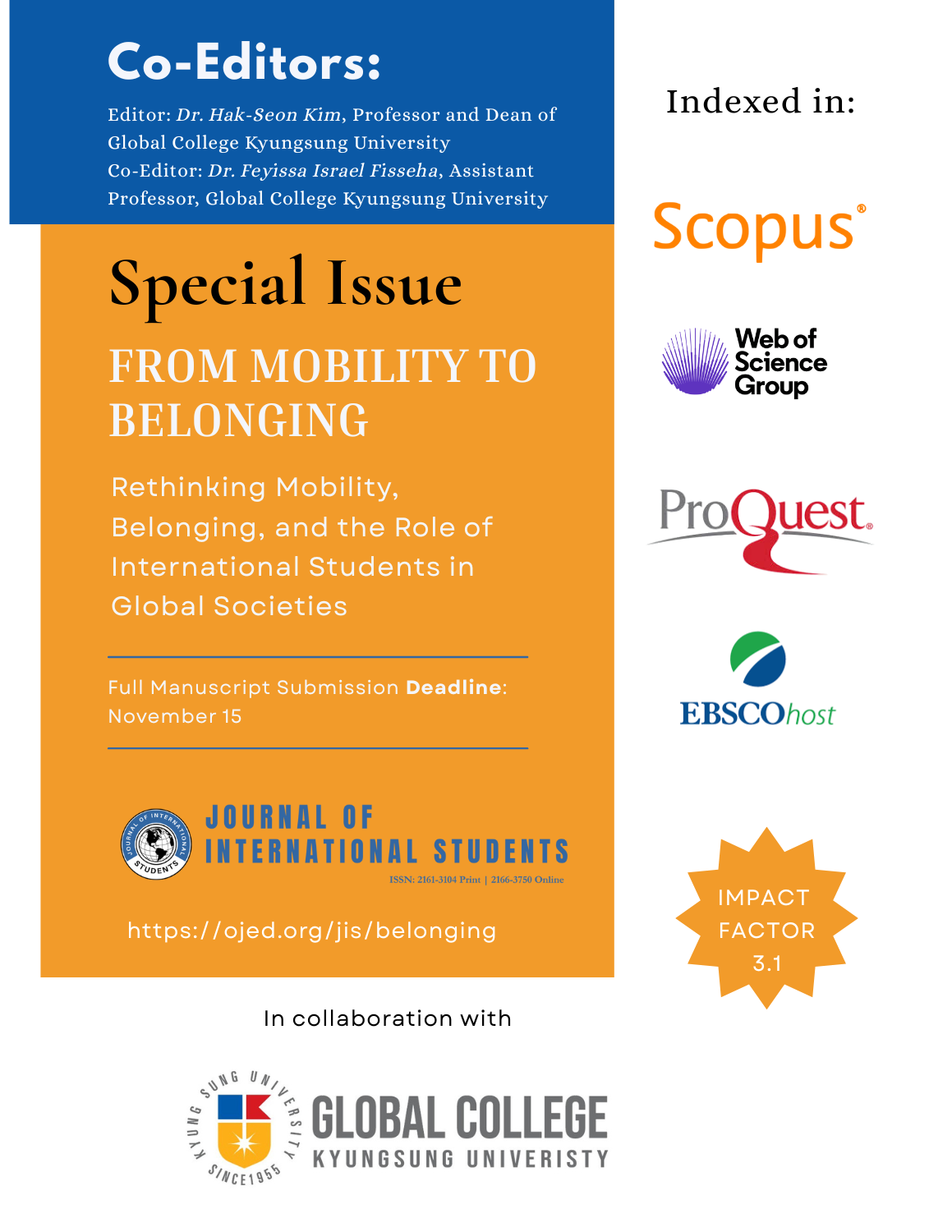
Call for papers: Rethinking Mobility, Belonging, and the Role of International Students in Global Societies
Editors
Hak-Seon Kim, PhD
Professor and Dean of Global College, Kyungsung University
Email: kims@ks.ac.kr
Feyissa Israel Fisseha, PhD, Assistant Professor and Director of the Global Migration and Integration Research Center, Global College Kyungsung University
Email: israel12@kyungsung.ac.kr
Scientific Committee for this volume
Dr. Richey Wyver, International college, Busan University of Foreign studies
Dr. Gabor Sebo, Palacký University Olomouc
Dr. Hyun-Jeong Ban, Global college Kyungsung University
Dr. Jue Wang, Global college Kyungsung University
Dr. Kumkum Jaiswal, Global College Kyungsung University
Background and Rationale
International student mobility is increasingly central to discussions on migration, globalization, and the knowledge economy. Students who cross borders for educational purposes represent critical intersections between internationalization strategies, labor market transitions, and social integration dynamics. Moving beyond traditional frameworks that view international students merely as temporary learners, contemporary scholarship frames them as agents of transnational mobility who actively negotiate institutional structures, local policies, and global labor market opportunities (King & Raghuram, 2013; Marginson, 2014).
The dual nature of international students—as migrants and emerging professionals—invokes critical migration concepts such as two-step migration, which emphasizes education as a strategic step toward longer-term residency and labor participation (Robertson, 2013). Furthermore, integration theory underscores that international students’ adjustment encompasses more than just academic success; it requires social, cultural, psychological, and structural adaptations essential for long-term belonging and employability (Ward, Bochner, & Furnham, 2001).
Empirical research from South Korea, a rapidly emerging destination for international students, reveals a nuanced relationship between integration programs and actual settlement outcomes. Specifically, institutionalized policies like the Korean Immigration and Integration Program (KIIP) are less influential than informal factors such as social networks, career opportunities, and personal life satisfaction (Kim & Feyissa, 2025). These findings parallel broader global studies demonstrating that formal policy structures alone do not guarantee successful integration; relational and experiential factors frequently determine the depth and quality of student integration (Rienties & Nolan, 2014; Tran & Gomes, 2017).
The ethical dimensions of higher education internationalization have also come under increased scrutiny, particularly concerning recruiting international students as economic resources or 'talent pipelines' for host nations (Stein & Andreotti, 2016). This raises questions about institutional responsibilities, ethical recruitment practices, and the sustainability of student mobility models across diverse geopolitical contexts.
This special issue seeks to broaden scholarly dialogue by inviting contributions that expand upon, critique, or offer comparative insights into these themes. While initiated from research focused on South Korea, this call encourages global perspectives illuminating diverse pathways of student integration, career development, and mobility in various international contexts. More at https://www.ojed.org/jis/belonging
Suggested Topics
We invite interdisciplinary submissions (empirical, theoretical, and policy-oriented) exploring:
- Belonging and identity negotiation across cultural and national contexts.
- Two-step migration and education-to-career pathways: opportunities and barriers.
- Employability, integration, and social mobility of international students across different local industries.
- Ethical and critical perspectives on the internationalization of higher education.
- Comparative integration frameworks and institutional roles across global contexts.
- Intersectionality (e.g., gender, race, language, class) shaping international student experiences.
- Emerging geographies of international student mobility: beyond traditional North-South flows.
- Retention, return, or onward migration decisions post-graduation.
Tentative Timeline
- Abstract Submission Deadline: August 1
- Abstract notifications: August 15
- Full Manuscript Submission Deadline: November 15
Manuscript Types
Research Articles (English): Research Articles (4,500-7,500 words) submissions use quantitative, qualitative, or mixed methods research to make significant advancement in under-researched aspects of the field related to topics outlined in the journal's Aims & Scope.
Research in Briefs (English): The "Research in Brief" section of the Journal of International Students is designed to concisely analyze specific topics or questions, using new or existing data sources. Articles should include a brief introduction, a discussion of the data, up to two figures/tables, a maximum of 10 references, and be within 2,000 words. Titles should be under 10 words, and an abstract of 120 words or less is required, and manuscripts undergo standard peer review.
Submission Process: Manuscripts should be submitted through the Journal of International Students' online submission system, adhering to the journal's formatting and referencing style. All authors contributing to this volume will receive a special publication rate, including discounts and waivers, which are available as applicable.
For inquiries, please get in touch with the Project Editor: FEYISSA ISRAEL FISSEHA, PhD
Email: israel12@kyungsung.ac.kr
References
King, R., & Raghuram, P. (2013). International student migration: Mapping the field and new research agendas. Population, Space and Place, 19(2), 127–137. https://doi.org/10.1002/psp.1746
Marginson, S. (2014). Student self-formation in international education. Journal of Studies in International Education, 18(1), 6–22. https://doi.org/10.1177/1028315313513036
Robertson, S. (2013). Transnational student-migrants and the state: The education-migration nexus. Palgrave Macmillan. https://doi.org/10.1057/9781137267085
Ward, C., Bochner, S., & Furnham, A. (2001). The Psychology of Culture Shock (2nd ed.). Routledge. https://doi.org/10.4324/9780203992258
Kim, Y., & Feyissa, I. F. (2025). Staying, leaving, or seeking more: International students' post-graduation settlement and migration decisions in South Korea. Journal of International Students. https://www.ojed.org/jis/article/view/7937
Rienties, B., & Nolan, E. M. (2014). Understanding friendship and learning networks of international and host students using longitudinal social network analysis. International Journal of Intercultural Relations, 41, 165–180. https://doi.org/10.1016/j.ijintrel.2013.12.003
Tran, L. T., & Gomes, C. (2017). Student mobility, connectedness and identity. Higher Education Research & Development, 36(6), 1184–1188. https://doi.org/10.1080/07294360.2017.1374406
Stein, S., & Andreotti, V. O. (2016). Decolonization and higher education: Locating the global. Critical Studies in Education, 57(3), 1–23. https://doi.org/10.1080/17508487.2016.1185644
In collaboration with